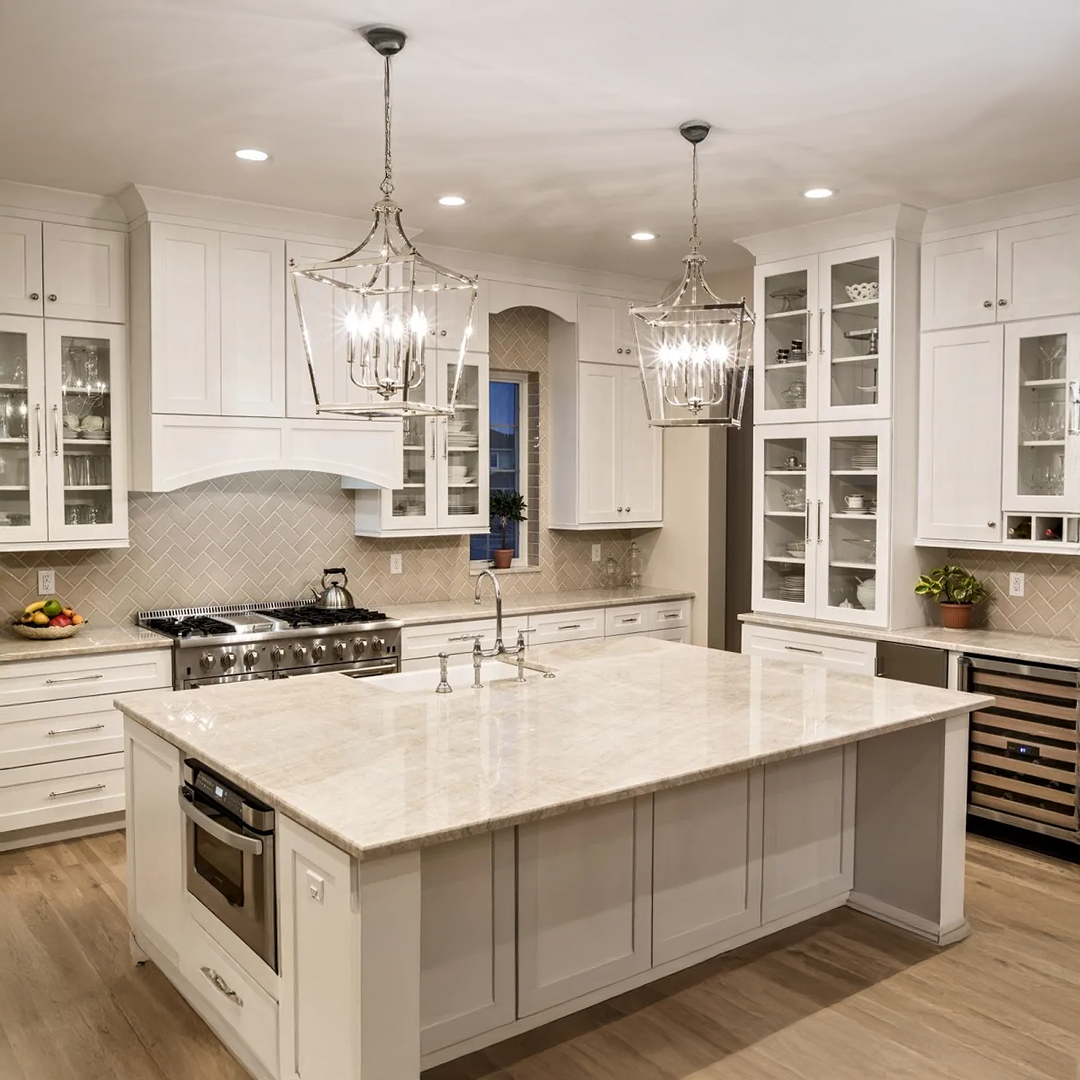
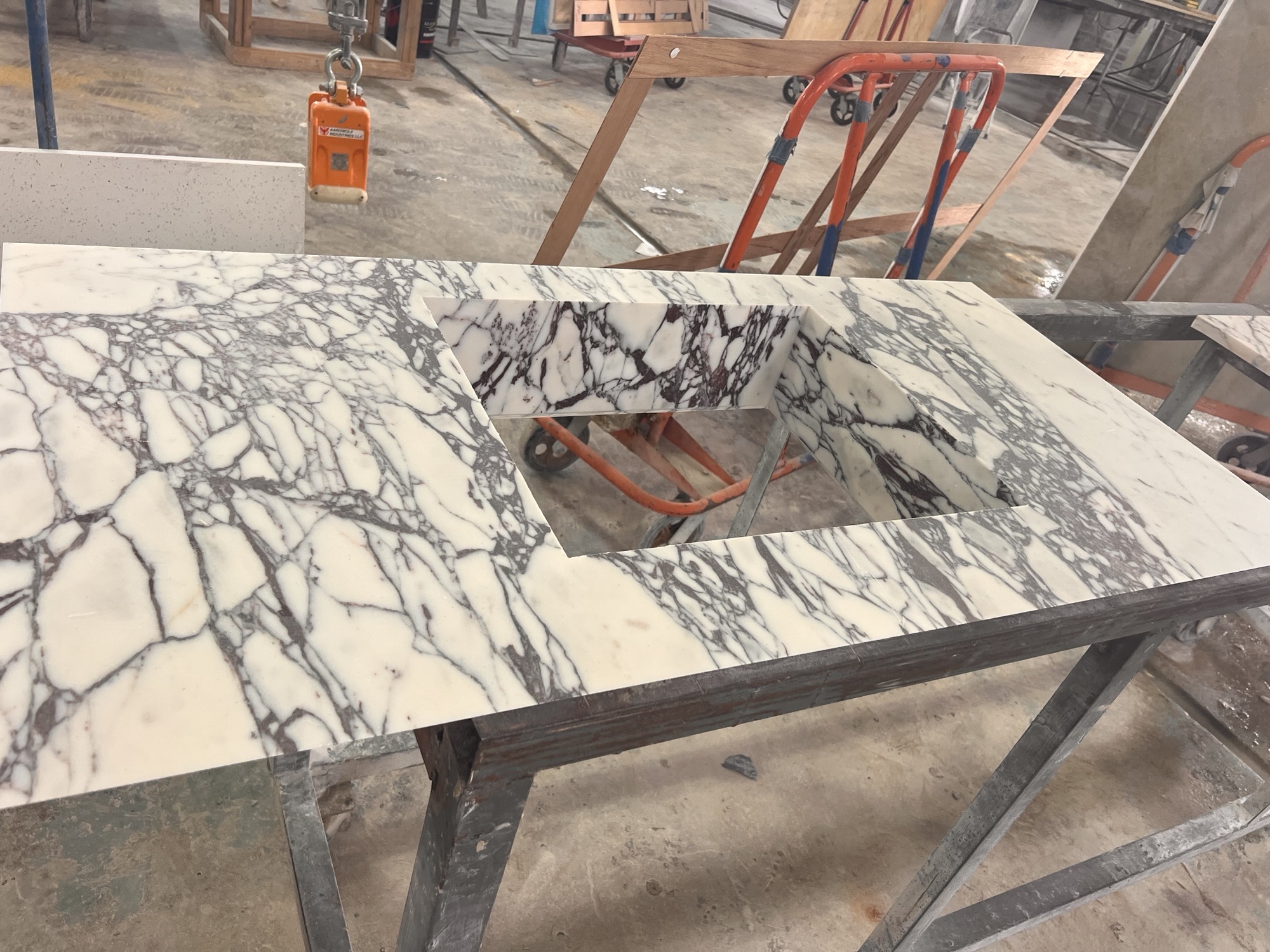
Calacatta Viola marble is a rare Italian stone prized for its striking veining in different shades of rich burgundy, plum, and violet-purple set against a warm white background. NaturaStone Design offers this stone for Orlando. Contact our team to check current slab availability.
In This Article
- What Is Calacatta Viola Marble?
- Why Designers Are Choosing Calacatta Viola Right Now
- Calacatta Viola Marble Countertops: What to Expect
- Calacatta Viola Projects by NaturaStone in Orlando
- What to Know Before You Buy
- Frequently Asked Questions
What Is Calacatta Viola Marble?
Calacatta Viola is a member of the larger family of Calacatta marble, which comes from one of the most mountainous areas in Tuscany, Italy, the same area that has provided the famous white marble to architects and sculptors over the years. The distinguishing features of Calacatta Viola are its colors. Unlike the typical gray or gold veining that most people think of when they hear Calacatta, this stone features deep violet, plum, and lavender veining that occurs in soft, irregular streaks throughout the stone.
A Calacatta Viola slab ranges in color from warm white or cream to ribbons of purple that can range from a light mauve to a deep saturated purple, sometimes turning to a grayish brown at the edge of the veins. No two veins are alike. Some flow in thin threads; others flow together into thicker, fog-like clouds. This is part of the charm; it’s a stone that is more like a painting than a building material.
Calacatta Viola is one of the rarest marbles that is offered in the global market. The violet is due to the presence of traces of minerals inside the stone formation, and blocks showing consistent and strong veining in violet color are very scarce and hard to find compared to the normal Calacatta in white or gold veining. Not all quarries make it, and even if they do, the quality of the violet character in the blocks is often more suitable for high-quality residential and commercial projects than mass distribution. The short supply is one of the factors that makes designers and homeowners willing to wait for the perfect slab.
Calacatta Viola is more dramatic and collectible than the standard Calacatta marble, which is characterized by softer gold or gray veining, and compared to more uniform Carrara marble with subtle gray veining and less contrast, is bolder. Carrara is the go-to option for those who prefer a more understated yet sophisticated vibe, while standard Calacatta offers a harmonious blend of grace and intensity. For the ones who prefer their stone to be the center of attention rather than a mere background feature, Calacatta Viola is the perfect option.
Why Designers Are Choosing Calacatta Viola Right Now
There has been a two-fold trend in interior design of late: minimalist luxury materials and maximalist “wow moment” materials. Calacatta Viola manages to be at the crossroads of both trends. Natural stone with the quiet luxury authenticity it needs, but with the drama it deserves with its veining in violet. Calacatta Viola will create a dramatic design statement with one waterfall island or bookmatched backsplash, without the need for any dramatic paint colors, patterned tile, or ornate decoration.
Rarity is playing a major role here, as well. With all the lookalike quartz products and engineered stone that are available today that look like marble veining, a truly rare variety of marble acts almost like a status symbol. Clients and designers who opt for Calacatta Viola are indicating that they looked for something special, something they can’t get in unlimited quantity from a catalogue. This want-it-all-now mentality that has been the hallmark of the fashion and art scenes is now being applied to high-end kitchen and bath design.
Calacatta Viola is most likely to look its best as a special feature, and not as a wall-to-wall surface in the home. Designers are most frequently incorporating it into kitchen islands, waterfall counter edges, powder room vanities, shower walls, and fireplace surrounds. In the use of stones, the stone receives room to breathe, ample continuous surface area to reveal the veining without any encroachment on cabinetry, fixtures, or other finishes. Using it as a small, broken fragment on a large number of separate surfaces (which is, in general, not desirable) is less common, but it is the concept of the stone’s movement over a large area of uninterrupted surface that makes it attractive.
Calacatta Viola Marble Countertops: What to Expect
Anyone thinking about using Calacatta Viola for countertops must realize it is a natural product, and not a manufactured product, which means that there is real variation.
- Veining variation. No two slabs (or even two ends of the same slab) are identical, for it is quarried stone. There are some slabs that lean towards a lavender grey and have fine veining, and there are others that have a concentrated violet clouding. It’s not an anomaly, but it does require that buyers consider and purchase what they see on the actual slab, and not just a sample chip.
- Thickness options. Calacatta Viola is usually sold in slab thickness dimensions as used for countertop and vertical applications, most typically around the 2cm and 3cm thickness, and sometimes the thicker slabs are preferred where the weight of the stone becomes important, like in a waterfall edge or statement islands, whereas the thinner slab thickness is suitable for backsplashes, vanities, or cladding.
- Finishes. A glossy, reflective surface is achieved, and the violet veining in the stone displays depth and contrast, making it more visible under kitchen lighting. A honed finish will create a matte, soft-touch surface which will help to reduce the veining slightly, and will often be used on bathroom vanities or for those clients who prefer a more subdued and modern look. Both finishes work, and this is typically a matter of the client’s opinion on how pronounced they’d like the stone to be in the space.
- Kitchens vs. bathrooms. Typically, in kitchen countertops, Calacatta Viola is installed on islands or countertops where the veining can easily be seen throughout the space, often complementing plain, neutral cabinets as a focal point. It is most commonly found on vanity tops, shower walls, and occasionally on floors in bathrooms, where smaller surfaces help create a jewel-box effect in the more intimate setting.
Calacatta Viola Projects by NaturaStone in Orlando
NaturaStone Design has selected and chosen Calacatta Viola for many residential projects in the Orlando area, and because the material is used in finished spaces, not just as a raw slab, it often helps to convince designers and homeowners to use it.
[Photo gallery: raw slab photography alongside finished installation photos]
- Waterfall Kitchen Island, Winter Park: This is a complete waterfall-edge island, made from one pair of bookmatched slabs, with a distinct and concentrated veining in violet color on both sides of the island.
- Primary Bathroom Vanity, Dr. Phillips: A brushed brass top and Calacatta Viola finishes, the muted tones of the violet vanity were a welcoming backdrop to the fixtures.
- Powder Room Feature Wall, Downtown Orlando: Full-height slab cladding as a dramatic feature wall in a small powder room, demonstrating the use of stone in a small space.
All of these projects were chosen by the slab NaturaStone went to in person and then manufactured specifically for the space, which is harder for competitors to achieve without first-hand knowledge of the rare stone and skills and knowledge of the in-house fabrication process.
What to Know Before You Buy
Available in a limited quantity, the availability of Calacatta Viola is not guaranteed. If a strong slab in the vein type the client desires enters inventory, it’s logical to assume it may not be available in a couple of weeks. When a slab’s favorite is discovered, people are typically told to press on and not hang around.
Calacatta Viola is definitely in the luxury range of natural stone, costlier than normal Calacatta and far more expensive than Carrara or typical granites, owing its exorbitant price to its scarcity and the pickiness required to find quarry blocks that have a significant violet presence. Slab sizes, veining intensity, and finish will all influence the pricing, and it is best to obtain a quote against a slab that has been selected.
Application and upkeep are standard procedures for natural marbles: it should be sealed at the time of installation and resealed periodically; cleaned with pH-neutral stone cleaners (acidic or abrasive cleaners should not be used); and protected from prolonged exposure to citrus, wine, or other acidic materials that can etch the polished surface. According to the Natural Stone Institute, proper sealing and pH-neutral cleaning are the two most important steps in protecting any natural marble surface. When taken care of with care, marble countertops endure and even acquire a “soft” appearance over time.
Also, it is important to be aware of the fabrication requirements of an exotic marble such as Calacatta Viola beforehand. For fabricators working with high-value natural stone, bookmatching, waterfall edges, and large single-slab applications demand experience with this type of material that can have a significant impact if the fabricator makes a mistake in cutting or seaming the slab. When the fabricator chooses the material for themselves, instead of from a sample photo, that risk is greatly diminished.
Frequently Asked Questions About Calacatta Viola Marble
What is Calacatta Viola marble?
Calacatta Viola is one of the more distinctive marbles in the Calacatta family, as it exhibits veining throughout its surface that has a violet and lavender hue on a white to cream-colored background.
What is the price of Calacatta Viola marble?
Calacatta Viola is in the luxury category of natural stone, higher than standard Calacatta and Carrara marble, depending on the veining of the slab, its size, and the finish chosen.
Is Calacatta Viola marble good for kitchen countertops?
Yes, it will work well for kitchen countertops and islands, especially as a feature surface, but, like any natural marble, it will have to be sealed and properly cared for to prevent etching from acidic products.
How rare is Calacatta Viola marble?
It is one of the less regular marble types on the market, as blocks with well-defined and uniform veining in violet are less likely to happen in the quarry than blocks with white or gold veining.
Does NaturaStone have Calacatta Viola marble in stock in Orlando?
NaturaStone Design currently has Calacatta Viola available in their Orlando stock as an option, depending on availability. Due to the rarity, stock changes frequently, so contact the company directly to ensure that the slabs available are current.
How do you maintain Calacatta Viola marble countertops?
Seal at installation and reseal periodically; use a pH-neutral stone cleaner to clean, and clean any food or liquids that have become acidic (wine, citrus, etc.) immediately. Do not use abrasive scouring pads, which may dull the polished surface.
Ready to see Calacatta Viola slabs in person? Schedule your appointment at NaturaStone Design in Orlando FL.